
Coroner's 'urgent concerns' over emergency care at Bassetlaw Hospital, following baby's death
Neglect by an emergency team at Bassetlaw Hospital contributed to the death of a 15-day old baby girl, an inquest found.
Following the inquest in to the death of Pyper Elliott, a senior coroner has warned that the paediatric resuscitation team at Bassetlaw Hospital in Worksop is unable to properly treat critically ill infants.
A formal Prevention of Future Deaths report released by the coroner raises urgent national safety concerns over emergency paediatric care at the Worksop site.
Law firm Ison Harrison, representing Pyper’s grieving family, has welcomed the report.
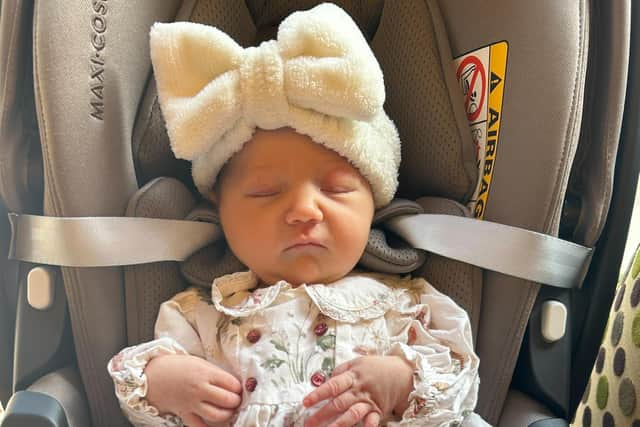

Pyper's parents, Kristen and Greg, said: “The trauma of witnessing the care Pyper received at Bassetlaw Hospital on the day she died has changed us as people and taken so much away from who we were before.
"We wish we could look back on those precious early days and remember them simply for the happiness Pyper brought us and her brothers, without the heartbreak of the circumstances surrounding her death overshadowing those memories.”
Pyper, born following an uncomplicated pregnancy, collapsed unexpectedly at home and was rushed to Bassetlaw Hospital’s emergency department in severe respiratory distress and acidosis.
Despite initial measures being taken, the inquest heard that the severity of her condition went unrecognised.

Critical airway management was delayed for more than two-and-a-half hours, long past the 30-to-40-minute window when intubation and mechanical ventilation should have taken place, at the latest.
Clinicians also failed to make an early referral to EMBRACE, Yorkshire’s specialist regional paediatric transport service, missing vital specialist guidance and transfer to a paediatric intensive care centre.
Recording a finding of neglect, the coroner concluded that basic life-saving treatment was not delivered and that earlier intervention and escalation would, on the balance of probabilities, have prolonged Pyper’s life for further stabilisation to have taken place.
Management of Pyper’s emergency care was described as "chaotic" by the coroner, marked by missing syringes, non-working infusion pumps, failures with baby-warming equipment, and staff struggling to locate and prepare emergency medicines.
The clinical team lacked an identified leader, leaving clinicians unclear about who was responsible for securing Pyper’s airway while individual tasks took precedence over overall patient oversight.
The resulting Prevention of Future Deaths report sent to Doncaster and Bassetlaw Teaching Hospitals NHS Foundation Trust warns that the hospital’s resuscitation team cannot provide the required management for a critically ill infant.
It stresses that trust simulation training fails to teach the team actions needed during a neonatal collapse and flags a dangerous breakdown in routine communication with regional critical care specialists at Sheffield Children’s Hospital.
The coroner has alerted both the Care Quality Commission and the local Integrated Care Board, noting an earlier Prevention of Future Deaths report had already been served on the trust over infant care at the same hospital.
Pyper’s parents said: “Pyper was an absolute dream. She was thriving, growing and gaining weight each day, and she had our whole hearts from the moment she came into this world.
"She was absolutely beautiful, with a head full of dark hair and the most piercing dark blue eyes. She was so calm and settled, and the two weeks we had with her were filled with nothing but love and cuddles.
“She completed our little family, and our lives will never feel quite whole without her.
"She will always be our beautiful little girl, and we will forever wish her story had been different.
“We placed our trust in the hospital staff to care for our daughter at her most vulnerable time, yet we both experienced overwhelming feelings of dread, terror and uncertainty because of the atmosphere and behaviour of those present that day.
“Since Pyper passed away in April 2025, the ongoing investigation and inquest have consumed our lives, leaving us feeling unable to grieve properly. Instead of simply remembering our beautiful little girl, we have been caught in an endless cycle of reliving the nightmare of how we lost her.
"We feel robbed of the opportunity to grieve without the trauma of her death overshadowing her memory.
“Revisiting these experiences is exhausting and haunting. We don’t know how we would have coped without the support of our patient safety advocate, Abbey, and our legal team.
"No words can truly describe the grief of losing a child, but to lose a child through professional failings amounting to neglect is something we will never be able to accept or come to terms with.”
Sadie Simpson, an inquest specialist at Ison Harrison who represents Pyper's family, is a leading authority on clinical failures in maternity and neonatal care.
She currently acts for dozens of families affected by maternity failings, including families involved in the high-profile Donna Ockenden independent review into Nottingham University Hospitals NHS Trust.
Sadie said: “A finding of neglect in relation to basic life-saving treatment for a neonate is harrowing. The family have had to fight tirelessly for answers, and I am proud to have stood by them in their search for the truth.
"I hope the Prevention of Future Deaths report brings about immediate, long-lasting change. Real change must and should be implemented, but unfortunately the coroner has no powers if changes are not made.
"This is another example why the organisation INQUESTs proposal for a National Oversite Mechanism should be created by the government to enforce change and save lives.
"No finding can undo the devastating and everlasting loss of Pyper, but the family wants the public to understand the gravity of the coroner's concerns so that real reforms are finally made.”
Doncaster and Bassetlaw Teaching Hospitals NHS Foundation Trust has been approached for a comment.